
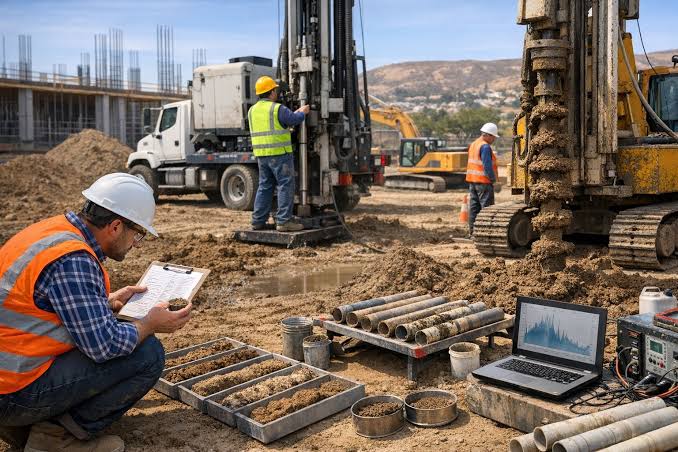
Every remediation project starts with an accurate picture of what a site is actually carrying. Our Site Investigation & Consulting service covers the full site evaluation: desktop reviews of land history, hydrology and proximity to industrial or petroleum activity, followed by on-site soil sampling and geotechnical profiling using grid-based borehole extraction and trenching methods.
Contaminant delineation relies on Total Petroleum Hydrocarbons (TPH), Polycyclic Aromatic Hydrocarbons (PAHs) and heavy metal screening, benchmarked against MOECC soil quality thresholds. Field techniques such as X-Ray Fluorescence (XRF), portable gas chromatography, and in-field colorimetric assays give real-time results, instead of waiting days for lab turnaround on every preliminary reading.
Our Key Focus Areas
Site investigation is only worth doing if the data it produces can actually be used. We model vertical and lateral migration pathways to work out risk plumes and plan intervention zones, and we look at soil stratigraphy, clay-sand ratios and organic matter to guide the remediation design that follows. This is not an afterthought. It feeds directly into the Remediation Action Plan (RAP) we prepare for MOECC approval.
24HR
Chain-of-custody sample transport window to MOECC-approved laboratories.
- Lab Turnaround Window
5
Core components in every RAP: characterization, risk analysis, technology selection, logistics, and compliance reporting.
- RAP Components
What You’ll Get
A site investigation engagement with us ends with documentation you can actually hand to a regulator or a lender, not a folder of raw lab sheets you have to make sense of yourself.

Site Characterization Report
Contamination profile, migration modelling and risk pathway analysis from desktop review through physical sampling.

MOECC-Ready Remediation Action Plan
A RAP structured to MOECC formats, with cleanup goals, technology selection and approval checklists built in from the start.

Closure Certification
Post-remediation verification report and certificate of soil clearance, structured to support land reuse permits and due diligence.
Frequently Asked Questions
Common questions about our site investigation & consulting service, process and MOECC compliance.
Phase 1 is a desktop review of land history, hydrology and prior industrial or petroleum activity on and around the site. Phase 2 moves to physical soil and groundwater sampling, using grid-based borehole extraction and trenching, to confirm or rule out contamination the Phase 1 review flagged as a risk.
We benchmark Total Petroleum Hydrocarbons (TPH), Polycyclic Aromatic Hydrocarbons (PAHs) and heavy metal concentrations against MOECC soil quality thresholds, using X-Ray Fluorescence, portable gas chromatography and in-field colorimetric assays for real-time readings alongside formal laboratory analysis.
A site characterization summary, risk analysis covering pathways and receptors, selection of the appropriate remediation technology for your soil and contaminant profile, logistics and safety controls, and compliance reporting templates formatted for MOECC review.
It depends on site size and access, but our four-phase Diagnose–Design–Deliver–Verify workflow is built for a MOECC-ready RAP without unnecessary delay between assessment and design.
Yes. We coordinate directly with MOECC’s Environmental Assessment Department, including pre-submission consultation on draft RAPs, so approval friction is handled before it becomes a schedule risk on your project.